Publications
Work in Progress
Faith, Interrupted: Names, Family, and Identity After Forced Atheism - JMP
Paper available upon request · with Enkelejda Havari and Michela Giorcelli
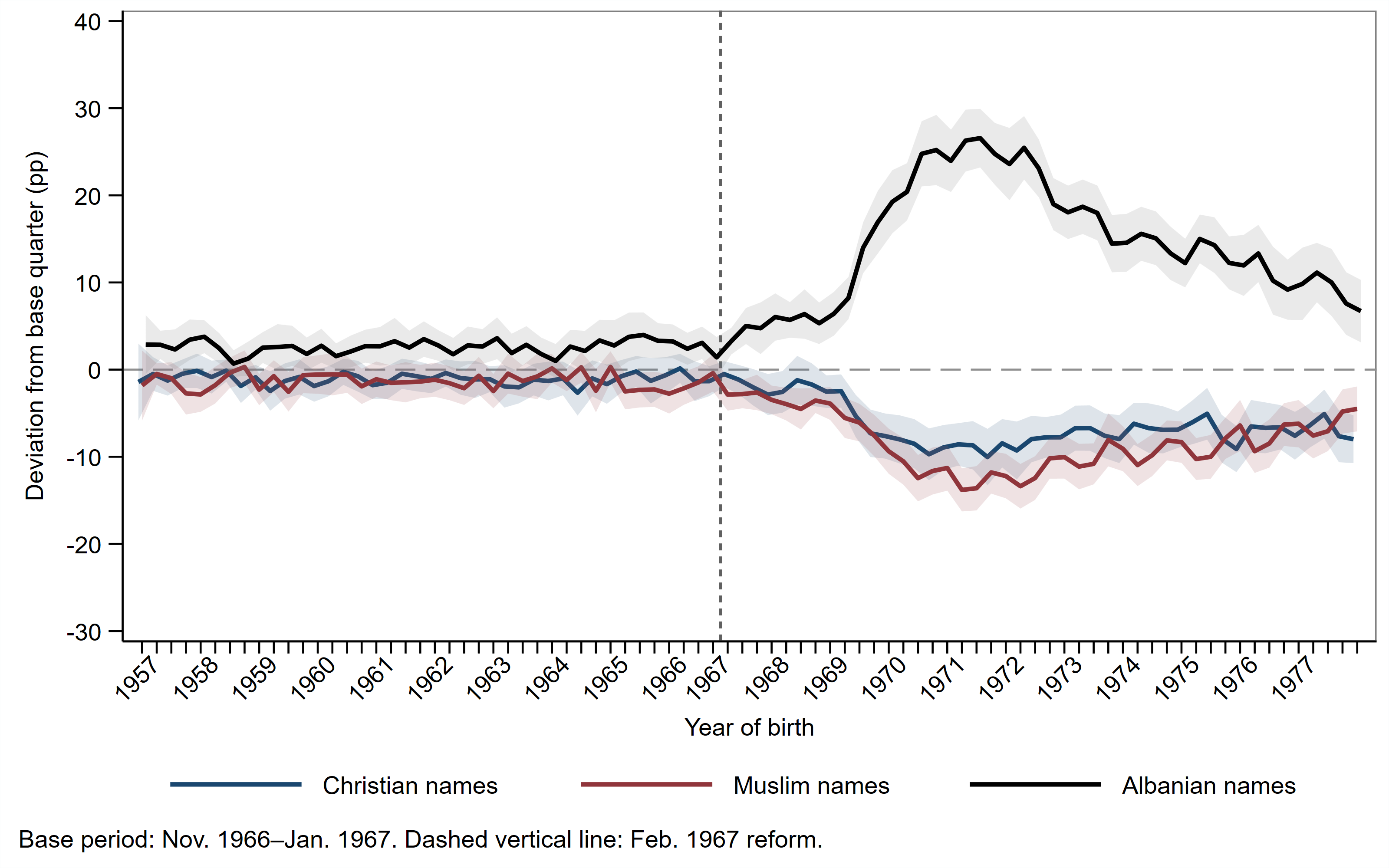
Can a state force people to change their identity, or only how they express it? We study Albania’s 1967 campaign, when the Communist regime banned religion and promoted a secular “pure Albanian” identity. Using a bunching design on decades of administrative naming data, we find religious names declined sharply — Muslim names by 29pp, Christian names by 15pp — while secular Albanian names rose by 30pp. Compliance was strongest in more illiterate districts and where a religion held majority status, and weakest where prior secularization or state support was highest. Muslim men, the dominant group, increasingly married secular women, while Christian men favored in-group marriage more after the reform. Yet survey data collected decades later reveal the limits of coercion: religious upbringing fell sharply among post-reform cohorts, but belief in God, comfort from religion, and political attitudes did not move at all. Even total, sustained, decades-long coercion could reshape cultural practices — with backlash — but not private beliefs.
Presentations
(2026) ASREC North America (California), CERGE-EI Brown Bag (Prague), ESPE (Helsinki), Kiel Institute for the World Economy (Berlin), Workshop on Gender and Economics (Luxembourg), IAAE (Lisbon), Women in Political Economy Workshop (Vienna); (2025) ASREC Europe Graduate Workshop (Copenhagen), CERGE-EI Applied Micro Seminar (Prague)
The Effect of Longer Maternal Care on Children’s Occupation Choices
CERGE-EI Working Paper
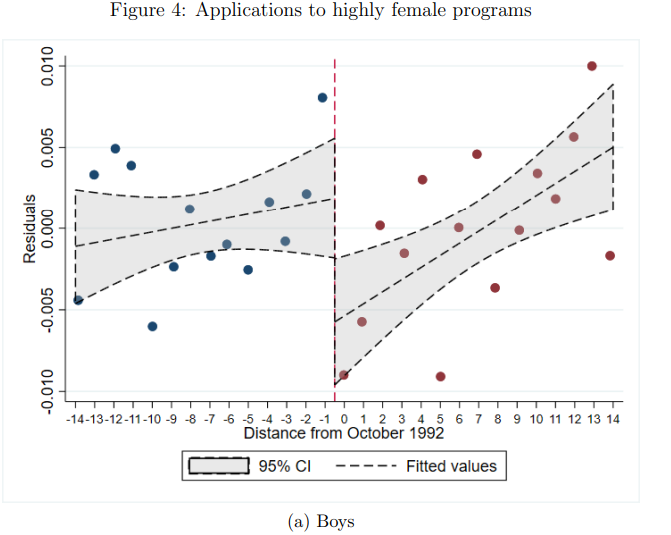
This paper investigates whether a mother’s extended provision of full-time childcare shapes her children’s preferences for occupation choices. I analyze a natural experiment in the Czech Republic that extended parental allowances by one year. This induced many mothers to remain out of the workplace and caused them to face a higher likelihood of long-term unemployment. This shift reinforced a more traditional, mother-as-homemaker dynamic within households. Using a regression discontinuity design, I measure their children’s later occupational preferences via their university applications. I find that boys who were exposed to the reform during early childhood were 20% less likely to apply to stereotypically feminine fields in adulthood, with no corresponding effect observed for girls.
Presentations
(2025) EWMES (Nicosia), 4th International Workshop on Migration and Family Economics (Paris), RES Annual Conference (Birmingham); (2024) Dissertation Workshop at CERGE-EI (Prague), 3rd Rare Voices in Economics Conference (Geneva), 3rd NSE PhD and Postdoc Workshop (Naples), PhD seminars at the University of Copenhagen and CEBI, 49th SAEe (Palma de Mallorca)
Awards
- 2025, Royal Economic Society: Best Conference Poster Prize [LinkedIn post]
- 2024, Czech Economic Society: Honourable Recognition by the President for an Excellent Paper award [Media]
- 2023, Charles University Grant Agency: funding awarded
Income Shocks and Firm Size in India
Paper available upon request · with Andreas Menzel
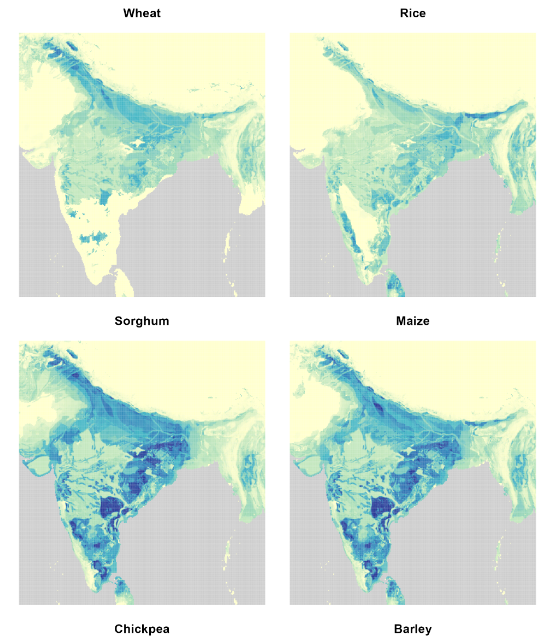
We study whether positive aggregate income shocks in local economies in India have positive effects on firm size, as measured by number of workers. We proxy local aggregate income shocks with predicted agricultural yields, based on rainfall data and soil suitability for different crops, to obtain exogenous variation in local incomes. We find that positive agricultural shocks are related to larger firm size in the ensuing years, though not in the same year. We also find positive effects of the same agricultural shocks on consumption indices, as well as on ownership rates of durables and transport vehicles. The firm size effects are driven by firms in manufacturing, transport, telecommunications and hospitality sector, broadly in line with the consumption results. These results are consistent with positive demand shocks spurring creation of new jobs in firms.
Published
Gender Gap in Reported Childcare Preferences among Parents
with Michal Šoltés and Filip Pertold
Review of Economics of the Household, February 2025
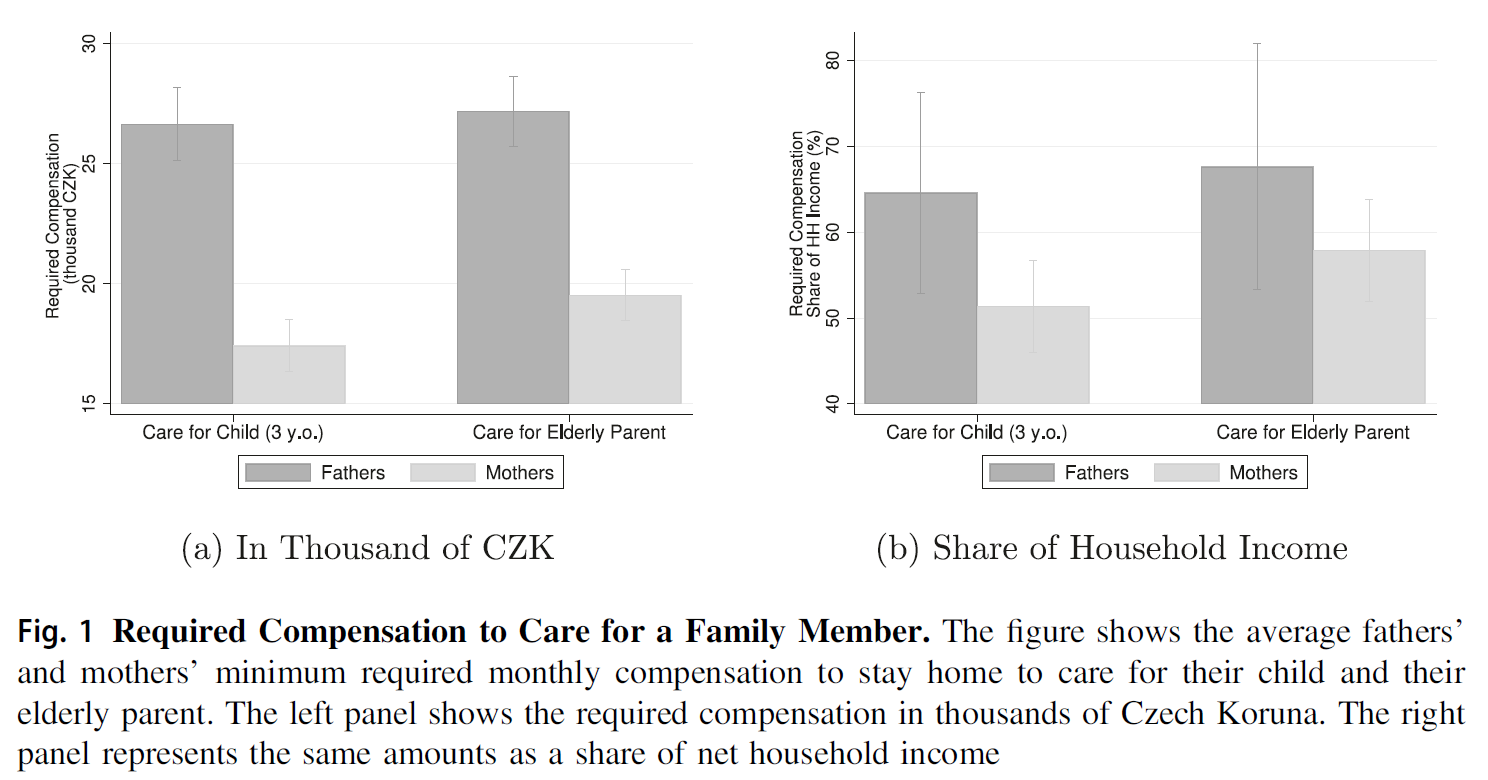
The child penalty explains the majority of gender employment and wage gaps; however, less is known about the factors driving the child penalty itself. In this paper, we study the gender gap in childcare preferences as a potential factor that contributes to the child penalty. We surveyed Czech parents and elicited the minimal compensation they would require to stay home to care for a child. Mothers require less compensation for childcare than fathers. The estimated gender gap in childcare preferences is CZK 2,500 monthly, 7.6% of the median female wage, and cannot be explained by differences in labor market opportunities or prosocial motives to care for a family member.